
Water as Memory and Change
Memoirs of a GeishaThis thread follows water imagery as Sayuri’s way of understanding vulnerability, adaptability, separation, and the changing course of her life.
increasing Bearing strength in each event
 decreasing
Bearing strength in each eventdecreasingThe Sea at Yoroido
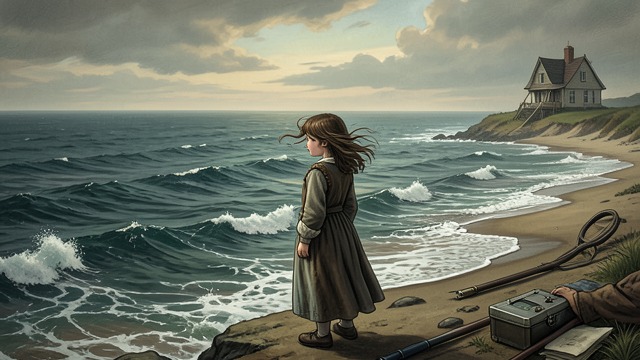
The Sea at Yoroido
A living landscape
As a child, Sayuri experiences the sea as a powerful presence surrounding her village. Wind, spray, waves, and the leaning family house make the natural world feel changeable and almost responsive to human feeling.
Water within the family
Her mother explains herself through water, while her father is associated with wood. Sayuri inherits her mother’s unusual eyes and imagines her own temperament through the same elemental language.
The image carried forward
These descriptions offer more than local color: they give Sayuri a vocabulary for the differences between people and for forces that shape a life. Water will later become her recurring figure for movement through circumstance.
Storm and Departure
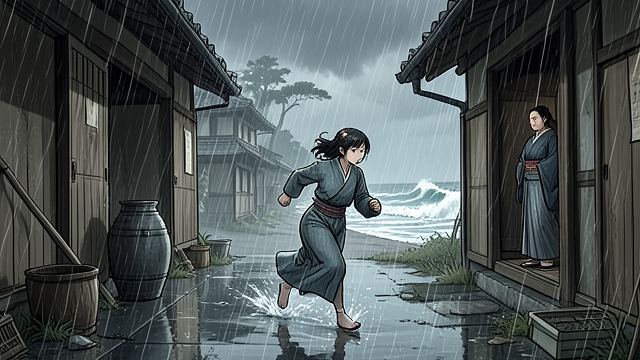
Storm and Departure
A world in upheaval
On the day Sayuri falls in the rain, the approaching storm mirrors her fear about her mother’s illness and the future of her family. The village’s familiar edge becomes a threshold: she leaves to fetch incense and instead meets the person who changes her life.
Water as disruption
The rain, rough sea, and wind are not simply a backdrop to the meeting. They make the world feel capable of sweeping away what has seemed permanent, an intuition Sayuri does not yet know how to interpret.
A beginning without consent
Her departure from Yoroido leads to a different life, but it is not a journey she freely designs. The storm image therefore joins possibility to loss from the outset.
The Water Lesson
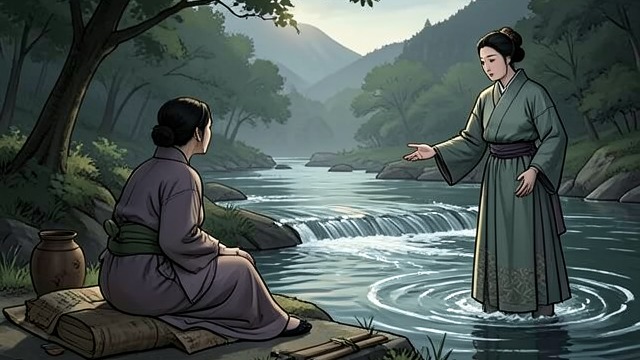
The Water Lesson
A metaphor for resourcefulness
Mameha tells Sayuri that water does not wait: it alters its shape, finds hidden paths, and works around barriers. The lesson recasts Sayuri’s supposed weakness as a potential form of intelligence and resilience.
A challenge to passivity
Sayuri has survived by enduring the decisions of others, but survival alone cannot restore her place in Gion. Mameha asks her to observe opportunities, learn the arts, and move strategically rather than assume that patience will change her circumstances.
Limits of the metaphor
The advice does not mean that every obstacle can be overcome. Sayuri’s later choices still expose her to consequences beyond her control; water becomes a language for adaptation, not a guarantee of victory.
The River of Exile
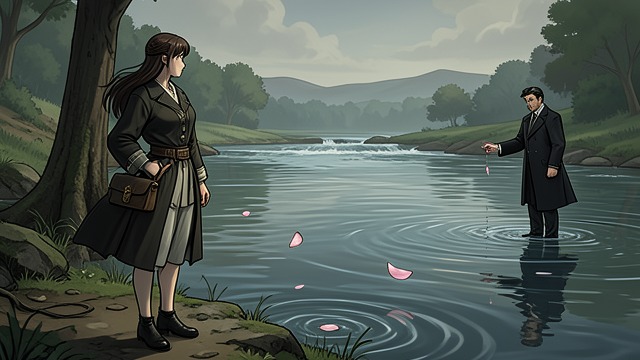
The River of Exile
A changed relationship to movement
Living away from Gion, Sayuri watches the Kamo River carry petals and scraps toward distant places. The current gives her a way to imagine connection across distance, especially when she fears that the Chairman will never think of her.
A return of earlier loss
Her memories of Satsu and the family she left behind surface alongside these images. Separation is no longer a single childhood event but a recurring condition that colors her sense of home and future.
An inward current
The river carries things without promising their arrival at any particular destination. Sayuri’s image of the Chairman receiving a floating petal expresses longing, but also the uncertainty built into her attempt to reach him.
From Current to Ocean

From Current to Ocean
A life seen from afar
In New York City, Sayuri reflects on the route from Yoroido through Gion and into a life shaped by the Chairman. Looking back lets her connect events that once seemed isolated, without making their painful consequences disappear.
Water and impermanence
She compares human life to a wave: vivid while it rises, but never permanent. Triumph and suffering alike eventually blend into a larger movement, like ink spreading across paper.
Memory as what remains
Sayuri cannot recover the past or undo what happened to Satsu, Nobu, or the Chairman. She can carry them within memory, finding continuity not in an unchanged world but in the meanings that survive change.
During Sayuri’s childhood in Yoroido
On the day Mr. Tanaka notices Sayuri in Yoroido
After Mameha meets Sayuri, before Sayuri’s debut
During Sayuri’s wartime years with the Arashino family
In the closing pages, as Sayuri reflects on her life in New York City
